New Trial Testing Teplizumab in Younger Children with Recently Diagnosed Type 1 Diabetes
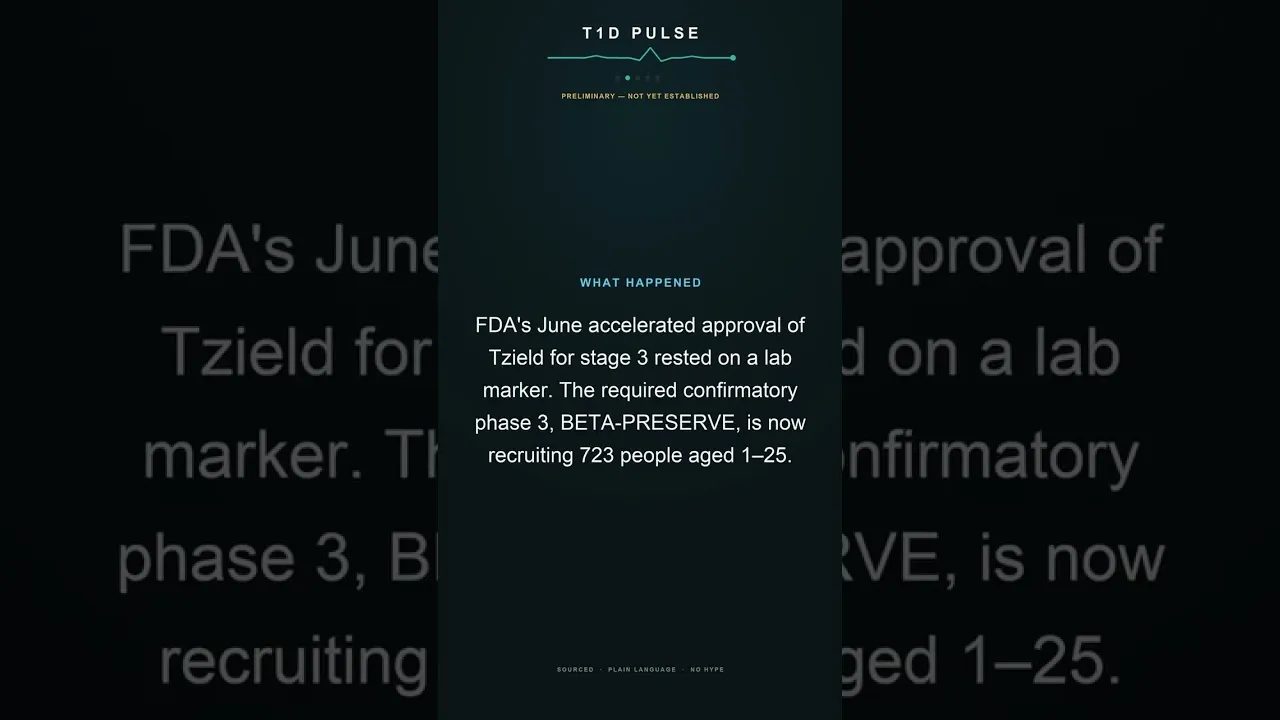
The FDA-required confirmatory trial BETA-PRESERVE is now recruiting children and young adults ages 1–25 to verify whether teplizumab can help preserve insulin production after a type 1 diabetes diagnosis.
Evidence label explains the kind of source behind this article (for example peer-reviewed literature vs community video). It is not medical advice.
Key takeaways
- Teplizumab (Tzield) received FDA accelerated approval in June 2026 for children ages 8–17 with recently diagnosed stage 3 type 1 diabetes based on C-peptide levels, a marker of remaining insulin production.
- The FDA required a follow-up study to confirm that delaying insulin loss actually improves patient outcomes in real-world conditions.
- BETA-PRESERVE is enrolling 723 participants ages 1–25 diagnosed within the past 8 weeks to compare teplizumab against placebo over one year.
- This trial expands the age range tested, including children under 8 for the first time, and will help clarify who might benefit most from treatment.
What Is Teplizumab and Why Does It Matter?
Teplizumab is a monoclonal antibody designed to slow the immune system's attack on insulin-producing beta cells in the pancreas. At type 1 diabetes onset, the body still produces some insulin—a window of opportunity that typically closes over months to years. Teplizumab aims to preserve that remaining insulin production for as long as possible.
In June 2026, the FDA approved teplizumab for children ages 8–17 with stage 3 type 1 diabetes diagnosed within the previous 8 weeks. The approval was based on accelerated review, meaning the FDA allowed market access earlier than usual based on promising early data showing that teplizumab slows the decline of C-peptide, a marker of insulin production.
Why a New Trial Is Happening Now
Accelerated FDA approval comes with a condition: the manufacturer must complete a confirmatory trial to verify that preserving C-peptide levels translates into meaningful clinical benefits for patients. The BETA-PRESERVE trial is that required study.
By confirming whether delayed insulin loss improves quality of life, reduces hypoglycemia, or changes long-term outcomes, this trial will help doctors and families understand whether teplizumab is truly beneficial in everyday practice.
Who Can Join and What to Expect
BETA-PRESERVE is recruiting 723 participants ages 1–25 who were diagnosed with type 1 diabetes within the past 8 weeks. This expands the age range beyond the original approval, including younger children ages 1–7 who have not yet been studied in a large trial.
Participants are randomly assigned to receive either teplizumab or placebo and are followed for 52 weeks. The trial will track C-peptide levels, insulin requirements, and other measures to determine whether teplizumab delivers the clinical benefits suggested by earlier studies.
If you are interested in learning more or joining, visit clinicaltrials.gov and search for study NCT07088068.
What This Means for You
This trial represents an important next step in type 1 diabetes treatment. Rather than accepting insulin loss as inevitable, researchers are testing whether we can slow it—potentially giving patients more time with residual insulin production and more stable blood sugar management.
If you or your child was recently diagnosed with type 1 diabetes, you may be eligible to participate. Your diabetes care team can discuss whether clinical trial participation is right for your situation. Participation in research helps answer these critical questions for everyone living with type 1 diabetes.
Evidence label
Origin: T1D Pulse (Video report). Evidence: Video report — unverified, pending corroboration. Type1Cure is an information and intelligence hub, not a medical advice service. This article summarizes published research and does not provide diagnosis, treatment, or personal medical guidance. Always talk to your own care team before changing anything about your Type 1 diabetes management.
Type1Cure is an information and intelligence hub, not a medical advice service. This article summarizes published research and does not provide diagnosis, treatment, or personal medical guidance. Always talk to your own care team before changing anything about your Type 1 diabetes management.
Related reading
More evidence-labeled coverage across the Type1Cure library.
- Cure & AdvancementsCell Replacement Therapy: A New Frontier in Type 1 Diabetes ResearchVideo report, corroborated with 5 indexed studies
- Cure & AdvancementsWhy Beta Cells Die in Type 1 Diabetes While Alpha Cells SurviveNews report, corroborated with 2 indexed studies
- Cure & AdvancementsEarly Trial Shows Some People with Type 1 Diabetes Can Reduce or Stop Insulin—Here's What We KnowNews report, corroborated with 3 indexed studies
- Cure & AdvancementsBeta Cell Therapy: Moving From Lab Promise to Real-World TreatmentVideo report, corroborated with 2 indexed studies
- Cure & AdvancementsUnderstanding the Eleodon Trial: What Early Results ShowVideo report — unverified, pending corroboration
- Cure & AdvancementsIslet Cell Therapies Advance: What You Need to KnowNews report, corroborated with 3 indexed studies